What dyslexia looks like in reading and writing
Dyslexia Assessment Dyslexia Assessment 8 min read
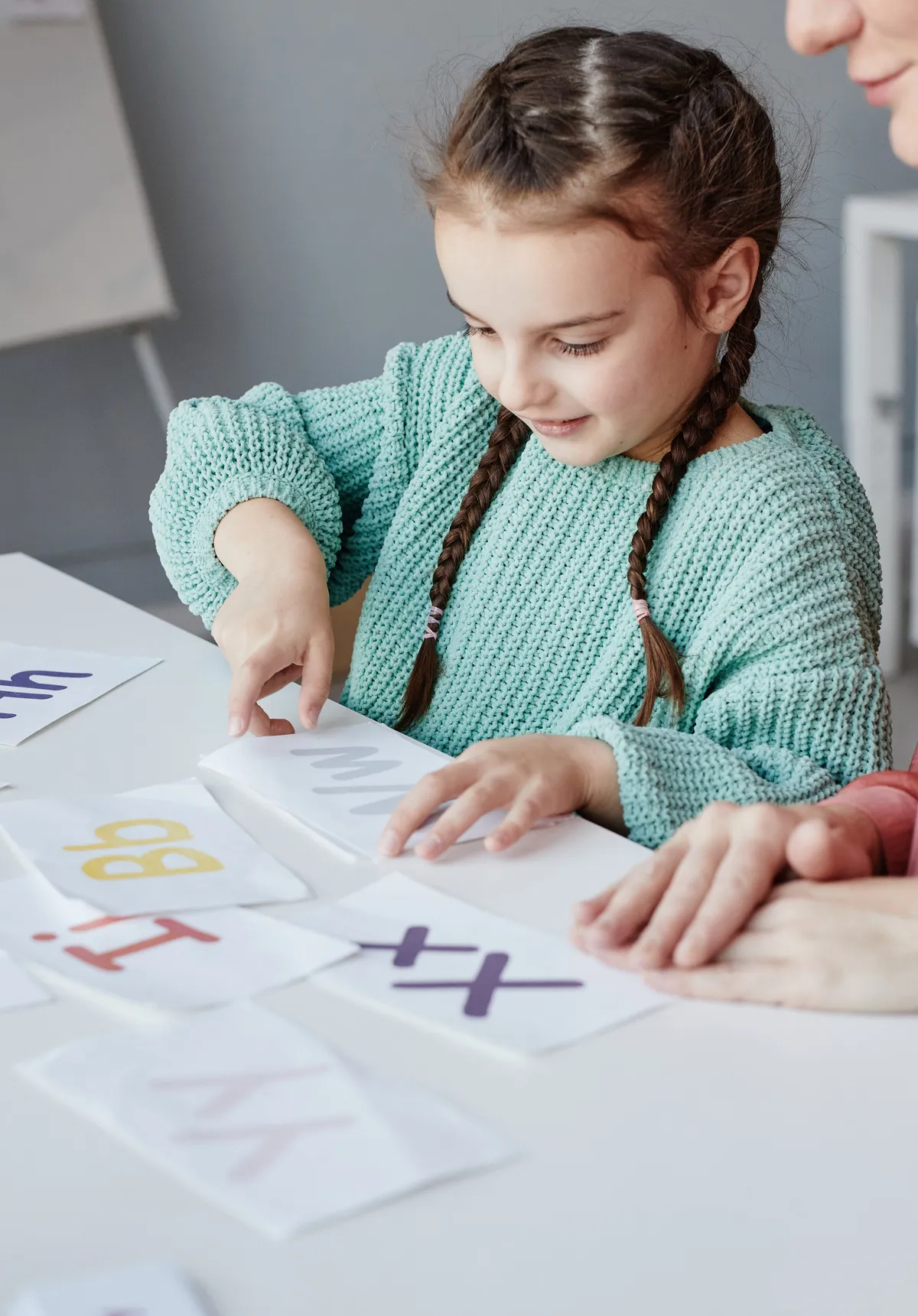
Dyslexia looks like slow, effortful reading and spelling that changes from one line to the next, often in a child who talks and understands far better than they read. It does not look like letters flipping or moving on the page, because dyslexia is a difficulty with the sounds in words, not with seeing them.
The examples below are typed illustrations written for this guide. They are not a real child’s work. Each pattern in them is one the sources at the end of this guide describe.
What does dyslexia look like when a child reads aloud?
Reading aloud with dyslexia is slow and uneven. The child works out many words one sound at a time, guesses at others, and has little attention left for the meaning.
Here is a sentence at a Year 3 reading level, and how a child with dyslexia might read it.
On the page: The children stepped carefully through the garden.
Read aloud (illustration): “The… ch, chil… children… stopped… car, care, careful… though the… grass.”
Each slip in that attempt has a cause.
| What happened | What it shows |
|---|---|
| “ch, chil… children” | The word is not yet known by sight, so it is rebuilt from its sounds every time |
| “stopped” for “stepped” | The first and last sounds were used and the vowel in the middle was guessed |
| “careful” for “carefully” | The ending was dropped because the effort went into the first part of the word |
| “though” for “through” | Similar-looking words are swapped when each letter and sound has not been worked out |
| “grass” for “garden” | A guess from the first letter and the meaning, not from the letters on the page |
| Long pauses, flat voice, no stops at commas | All the attention is on the words, so none is left for the sense of the sentence |
Two more things are typical. A word read correctly in the first line, such as “carefully”, can be sounded out from scratch, or guessed, when it comes back three lines later. And when you read the same passage to them, they often understand it much better. That gap between listening and reading is one of the clearest things to look for.
What does dyslexia look like in a child’s spelling and writing?
In writing, dyslexia looks like spelling by sound, and the same word spelled several ways on one page. The ideas are usually better than the writing shows.
Writing sample (illustration): “On Saterday my frend cam to my howse. We bilt a cubby becos it was raning. My frend sed it was the best cuby ever. We staid in it becuse of the rane.”
Read it aloud and it makes sense. That is the pattern: the child is writing down the sounds they hear, because the letter patterns of the words have not stuck.
| Spelling in the sample | Correct word | What it shows |
|---|---|---|
| becos, then becuse | because | The same word is rebuilt from its sounds each time, so it comes out differently |
| cubby, then cuby | cubby | A word spelled correctly once is not yet stored firmly |
| frend, sed, howse | friend, said, house | Common words spelled the way they sound |
| cam, raning, rane | came, raining, rain | The vowel sound was heard, but the letter pattern that spells it was not remembered |
| bilt, staid | built, stayed | A sensible guess at a pattern the child has seen but cannot recall |
A child who spells this way may learn the words for Friday’s spelling test and have lost them by the next week. Raising Children Network lists this as a sign in school-age children: struggling to remember words even after reading and writing them many times. Many children also start choosing short, safe words, so the writing looks younger than the child sounds.
Do people with dyslexia see letters backwards or moving?
No. A dyslexic person sees the same letters on the page as any other reader. The difficulty comes afterwards, in matching those letters to sounds. The Yale Center for Dyslexia and Creativity calls the idea that children with dyslexia see letters and words backwards a myth. The International Dyslexia Association says the same of reading backwards. healthdirect, the government-funded health information service, states that dyslexia is not caused by problems with eyesight.
Videos that show letters jumping or swapping places are trying to show how frustrating reading feels. They are not what a person with dyslexia sees. A child who says the words “move” or “go blurry” should still have their eyes checked: healthdirect advises a vision and hearing check for any child who is struggling to read. It also notes that coloured lenses, coloured overlays and eye exercises do not help people with dyslexia.
Is reversing b and d a sign of dyslexia?
Not on its own. Mixing up b and d is common in beginning readers and writers, and most children who do it do not have dyslexia.
The letters b, d, p and q are one shape turned four ways. Nothing else a young child has learned changes its name when it faces the other way, so it takes time to settle. Yale’s dyslexia centre notes that many young children reverse letters when learning to write, whether or not they have dyslexia, and that most children with dyslexia do not reverse letters. Understood, a US learning differences organisation, says most children stop reversing letters by the end of their second year of school.
A b and d reversal means more when it lasts past the first two or three years of school and comes with other signs. Those are slow sounding out, guessing at words, and spelling that will not stick. Even then the cause is not that the child sees the letter backwards. They are unsure which sound belongs to which shape.
Why is dyslexia a difficulty with sounds and not with sight?
Dyslexia is a difficulty with the sounds inside words. To read “ship” a child has to know that it is three sounds, sh, i and p, and which letters stand for each one. To spell it they have to pull the word apart into those sounds and write them in order.
The International Dyslexia Association says most people with dyslexia have trouble identifying the separate speech sounds within a word, or learning how letters represent those sounds. Yale describes it as a problem with getting to the sounds of spoken language. In its words, “It is not a visual disorder.”
That one difficulty explains every example above. Words that cannot be matched to their sounds quickly have to be sounded out or guessed. Spellings that were never tied to their sounds do not stay in memory. This is why a dyslexia assessment looks at how a child hears and works with sounds as well as how they read and spell.
What does dyslexia handwriting look like?
There is no such thing as dyslexia handwriting. Dyslexia shows in the spelling, not in the shape of the letters.
What you may see on the page of a child with dyslexia:
- words crossed out and tried again two or three times
- writing that is slow, so little gets finished
- spelling that changes from line to line
- writing made deliberately messy, which Raising Children Network notes some older children use to hide weak spelling
What points somewhere else:
- letters that are badly formed, uneven in size or drifting off the line
- an awkward or painful pencil grip
- a hand that tires after a few lines
Those are signs of a handwriting difficulty, sometimes called dysgraphia. The International Dyslexia Association notes that it can occur on its own or together with dyslexia. The mechanics of handwriting are usually looked at by an occupational therapist, and are not part of the assessments on this site. The differences are set out in dyslexia, dysgraphia and dyscalculia.
What does dyslexia not look like?
Several things are often taken for dyslexia and are not, at least on their own:
- Low intelligence or laziness. Dyslexia occurs at every level of ability, and the Australian Dyslexia Association notes that most children with dyslexia have to work much harder than their peers.
- A vision problem. Glasses fix blurry print. They do not fix dyslexia.
- Reversing b and d at five or six. This is part of learning to write.
- Messy handwriting with good reading and spelling. That is a handwriting question.
- A slow start that clears up quickly with good teaching. healthdirect notes that some children make rapid progress once they get targeted teaching. A child who catches up quickly like that was more likely missing teaching than showing dyslexia, which is the difficulty that stays.
Other conditions can produce some of the same signs, and dyslexia or something else covers how they are told apart.
When is it worth having it looked at?
A child’s reading and spelling are worth having looked at when the patterns above last. One sign on one day means little. Slow sounding out, guessing, and spelling that will not stay, still there after a year or more of reading teaching, are a reason to look closer.
The signs of dyslexia are listed by stage, and the free dyslexia screener takes a parent through the main ones. It is a screener, not a diagnosis.
A dyslexia assessment with Dr Lauren Crumlish (PhD), Certified Practising Speech Pathologist, looks at how a child reads and spells and at the language skills underneath, online, for school-aged children and teenagers anywhere in Australia. It shows where reading and spelling are breaking down and what to work on. A formal dyslexia diagnosis is usually made by a psychologist, and how dyslexia is diagnosed explains who does what.
Sources
- Yale Center for Dyslexia and Creativity, Dyslexia FAQ
- International Dyslexia Association, Dyslexia Basics and Understanding Dysgraphia
- healthdirect, Dyslexia
- Raising Children Network, Dyslexia in children and teenagers
- Understood, FAQs about reversing letters
- Australian Dyslexia Association, Identifying dyslexia
- British Dyslexia Association, Signs of dyslexia (Secondary school age)
Topics
- Signs
- Reading
- Spelling
- Letter Reversals
- Handwriting